
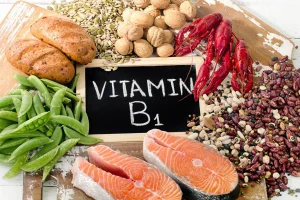
 What is Vitamin B1 – Thiamine?

Key facts: Thiamine is a water-based vitamin and is found naturally in many foods, Thiamine plays a critical role in the production of energy from food, especially carbohydrates.
What Does Thiamine (Vitamin B1) Do?
Contributes to your heart function, energy creation and the maintenance of your mental and emotional state. Thiamine helps the body make use of protein.
Top Tip
Studies have shown that people over 50 with higher intakes of thiamine are less prone to cataracts. This book has an interesting chapter on cataracts; Nutrition and the Eye.
What Happens if You Don’t Have Enough?
Although beriberi is uncommon in affluent nations, severe thiamine deficiency can result in illness. If you don’t consume enough thiamine through your diet or if your body excretes too much or absorbs too little, you could develop thiamine deficiency. Loss of appetite, disorientation, memory loss, muscle weakness, and cardiac issues are all symptoms of thiamine deficiency. Some medicines can lower thiamine levels in the body, for example, Furosemide, which is used to treat high blood pressure.
What Happens if You Have Too Much?
Thiamine has not shown to be harmful. No upper limit known for adults.
If you take Thiamine supplements they are unlikely to cause side effects unless you are hypersensitive to Thiamine or one of the ingredients of Thiamine.
What Are the Best Sources of Vitamin B1 – Thiamine?
| Thiamine recommended amount (RDI) you need | |
| Age | mg Per day |
| Male 19 – 50 | 1.0 mg |
| Male 50+ | 0.9 mg |
| Female 19 – 50 | 0.8 mg |
| Female 50+ | 0.8 mg |
| mg = milligram per day | |
You can get recommended amounts of Thiamine by eating a variety of foods.
Thiamine is present in many foods including legumes, pork and white fish such as trout. Good sources of Thiamine include peas, lentils and beans, yeast or beef extracts (including Marmite and Bovril) eggs, oranges and orange juice, wheat bran and other wholegrain foods, pork, beef, liver and fish.
Here is a food example: Trout: Low FODMAP Allergens: Fish
The best cooking method is steaming as this reduces the toxins the fish may have absorbed from the water.
| Trout | 120g | |
| Thiamine | 0.07mg | 6% RDA |
| High in Protein | 20g | 36% RDA |
For safety, before taking a course of Thiamine supplements tell your doctor or pharmacist if you’re taking any other medicines, including herbal medicines, vitamins or supplements. Best supplemented as part of a B complex supplement with food.
Top 6 Food Sources for Vitamin B1 – Thiamine
- Pork lean cuts 225g Nutrient (Thiamine) 2.21mg
- Pork shoulder cuts 225g Nutrient (Thiamine) 1.28mg
- Pork filet 150g Nutrient (Thiamine) 1.22mg
- Pork loin chops 250g Nutrient (Thiamine) 1.19mg
- Pork loin joint 225g Nutrient (Thiamine) 1.17mg
- Pork chops chump 250g Nutrient (Thiamine) 1.17mg
Top 6 Vegetarian Food Sources for Vitamin B1 – Thiamine
- Orange juice – carton 200g Nutrient (Thiamine) 0.66mg
- Pizza base – retail 150g Nutrient (Thiamine) 0.62mg
- Orange juice – made from concentrate 200g Nutrient (Thiamine) 0.56mg
- Black bean sauce 50g Nutrient (Thiamine) 0.51mg
- Crunchy cluster cereal – no nuts – unfortified 50g Nutrient (Thiamine) 0.51mg
- Sesame flour – high fat 16g Nutrient (Thiamine) 0.43mg
I hope this blog was helpful and may have answered some of your questions and dispelled some worries. Only a GP can examine you for a deficiency in Thiamine so get check before you take supplements and do read once again the best foods that contain Thiamine.
Best wishes,

Steve Walsh
Nutrition & Health B.A. (Hons)
Liverpool Hope University
