
 What is it that dictates whether we’re able to see or not to see? Or how well we’re able to see when we can? Well, there are a great many factors involved, when it comes to our sight, and the eye is an incredible biological device. Did you know, for example, that “Experts estimate that we can distinguish perhaps as many as 10 million colours”?* Here’s
Light Sensitive Cells
Colour is often mistaken as a property of light when it really is a property of the brain. Our experience of colour depends not only on the wavelength of the light rays that hit the retina, but also the context in which we perceive it, things such as background colours, lighting, familiarity, and surroundings.
Within the retina are buried receptor cells called RODS and CONES. When light energy strikes them, neural signals are created as a result of chemical changes. The signals are then routed through neighboring bipolar and ganglion cells that form the optic nerve. This nerve then transmits information to the brain’s visual cortex.
Our 120 million rods are responsible for our perception of black, white, and grey. They are the most sensitive in dim light.
There are three types of cone Red light, Green light and Blue light.
There are 6 million cones, what enable us to see colour and fine detail. They function in well-lit conditions and become ineffective with diminished illumination.
Common Defects of the Eye
Myopia (Short Sightedness)
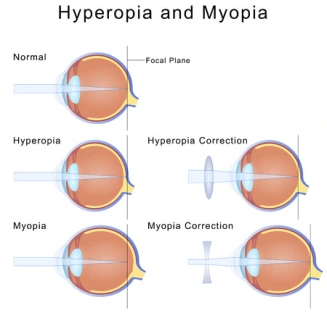
Myopia is caused by an eyeball that is too long, or weak suspensory ligaments that cannot pull the lens into a thin shape. Someone with short sight can see near objects clearly but their far point is closer than infinity. This means they cannot focus properly on distant objects. Short sight is caused by one of the following, the eyeball being elongated so that the distance between the lens and the retina is too great, or the lens being too far and curved, so that light is focused in front of the retina.
A concave lens corrects short sightedness

Hyperopia (Long Sightedness)
Hyperopia is caused by an eyeball that is too short, or a lens that stays too long and thin. Someone with long sight can see distant objects clearly, but their near point is further away than 25cm, this means they cannot focus properly on near objects. Long sighted is caused by one of the following, the eyeball is too near so the distance between the lens and the retina is too small, or a loss in elasticity in the lens, meaning it cannot become stretched enough to focus (which is often age related).
Treatments for Vision Defects
Wearing glasses isn’t for everyone. Here are some alternatives:
Contact Lenses
Contact lenses are thin lenses that sit on the surface of the eye and are shaped to compensate for the fault in focusing. The two main types of contact lens are hard lens and soft lens. Soft lenses are generally more comfortable but carry a higher risk of eye infection than hard lenses.
Laser Eye Surgery
Bad eye sight can sometimes be corrected with laser surgery. A laser can be used to vaporise tissue.
Replacement lens surgery
Sometimes long sightedness may be more effectively treated by replacing the lens of an eye (rather than altering the shape of the cornea with laser eye surgery).
* Wyszecki, Gunter. Color. Chicago: World Book Inc, 2006: 824.
Best wishes,

Steve Walsh
Nutrition & Health B.A. (Hons)
Liverpool Hope University
